
Not much is out on it as much as it's cousin the CTS 1. It appears to have been on the available prior to the CTS 1 but never caught on. Is there any more information anyone has on it, like when did it hit the market, who used them, was it any good, and when was it discontinued?
You are using an out of date browser. It may not display this or other websites correctly.
You should upgrade or use an alternative browser.
You should upgrade or use an alternative browser.
Federal CT-1 lightbar
- Thread starter 1968
- Start date
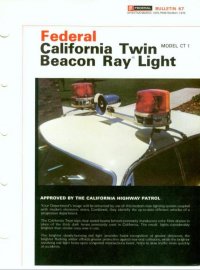
The CT-1, known as the California Twin Beacon Ray, utilized a pair of what appeared to be a pair of 184 beacons on a Visibar. The 184 on the passenger side was a standard version Model 184, the one on the driver's side lacked a motor and instead had a forward facing, steady burn PAR-46 lamp and a rear facing PAR-46 connected to a flasher. The dome on the driver's side was a split color, with red to the front and amber to the rear. It was advertised in Bulletin 67, which had an effective date of March, 1970, printed May, 1975, so it was definitely available from 1970 through 1975. That's about all I can tell you.




May be Eric6913 has (or could make) one, cause he has one CT-1 in his collection.Does anyone have a video?
Visibar factory standards?
Got the chance to buy this lightbar, wondering was the Visibar fully configurable or did Federal Signal make factory standards? thus is this one factory standard?
 elightbars.org

Yes, Eric has a beautiful one (albeit displayed on green astroturfDoes anyone have a video?
 !) and I recall someone else posting their proposed (or completed) restoration a couple of years ago. Pretty massive!
Seeing as how so few exist today, I'd say production numbers were quite limited. It's much easier to find a CTS TwinSonic than it is to find a CT 1 bar.

I seem to recall SFPD tested/used the CT-1 after the spartan single roof mounted Unity spotlight steady burn…you know, with the scull scraper handle protruding into the pass compartment. I’ve slept since then and now it’s cocktail hour….
Are you referring to this light when you stated "spartan single roof mounted Unity spotlight steady burn…you know, with the scull scraper handle protruding into the pass compartment." https://www.foundsf.org/images/9/9b/Sfpd-squad-car-by-Panhandle_00070003_Chuck-Gould.jpg
Yup, but I said I’d slept since then. Great pic, thanks!Are you referring to this light when you stated "spartan single roof mounted Unity spotlight steady burn…you know, with the scull scraper handle protruding into the pass compartment." https://www.foundsf.org/images/9/9b/Sfpd-squad-car-by-Panhandle_00070003_Chuck-Gould.jpg
I remember seeing a picture of a whole parking lot full of them.
I also have seen some with a blue dome on the rotator side.
I also have seen some with a blue dome on the rotator side.
That's a 1973 Ford Torino sedan, I can recognize the 5 mph front bumper and and the old, 1972 style rear bumper from 100 yards away.I believe this is the only example I can find.


Do you know the name of the Department?I believe this is the only example I can find.
Do idea on the department, I just recognized the specific year of the car. I'm a Ford fan.Do you know the name of the Department?

Let's see if I can mak


Let's see if I can make those pics display directly here on the forum...

Not really and certainly less than a CTS TwinSonic. The 184 beacon had four 30 watt bulbs or 37.5 watt bulbs with the quartz halogen bulb option, a CTS TwinSonic had four 60 watt bulbs.That set up has got pull some serious amperage. Would be cool to have in the collection.
Oh I didn't know the came with 30 watters in it. I figured 60s. My uncle was PD and mentioned back in the day with a the multiple rotator bar going with sealed beam traffic wigwags in the back window, radio ect... Created a hell of a pull on the electrical.
The only bars or beacons with factory installed 60 watt 4464 bulbs were the TwinSonic, the AeroTwinSonic, the Model 16 Visilite (single bulb) and 312 Titan (two bulbs) beacon. All the rest came with 30 watt bulbs, but around 1977-78 Federal offered the 37.5 watt quartz halogen 7600 bulb as an option in all of their beacons and light bars except for the 17/173-175 Beacon Ray. For some reason, probably the use of wires to power the bulbs instead of copper contacts, Federal did not ship the classic Beacon Ray with anything more than 30 watt bulbs.Oh I didn't know the came with 30 watters in it. I figured 60s. My uncle was PD and mentioned back in the day with a the multiple rotator bar going with sealed beam traffic wigwags in the back window, radio ect... Created a hell of a pull on the electrical.
The only ad I have seen for the 171 is dated 1958. I've not seen any Model 171's show up nor pictures of any, so either they sold in very low numbers or there was no interest whatsoever by potential purchasers and it was quickly dropped from the catalog. Without further evidence, determination of what bulbs were used in the 171 is pure speculation.Possibly the Model 171 beacon Ray had high powered bulbs, 1968 vintage?
I may have mis coppied the date from the light/siren dated thread. I agree on rarely seen. I think I've seen one advertised at one point, ever
This and the thread on the 15S are great. This was the fun we had on this site years ago, LOL. Many heads investigating and usually coming to an answer.
This and the thread on the 15S are great. This was the fun we had on this site years ago, LOL. Many heads investigating and usually coming to an answer.
Talk about a Blast from the past.....Do you know the name of the Department?
It was either Arcadia, Calif. PD or somewhere close to it.


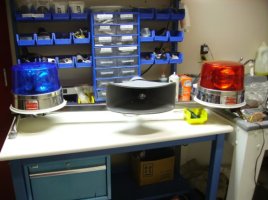

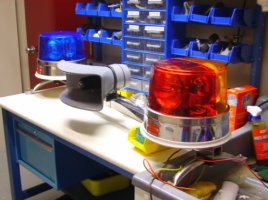

Very Nice Oliver
The original thread that @ERIC6913 posted is here: https://elightbars.org/forums/threads/finally-my-long-awaited-federal-ct-1-project-finished.6803/

I had a discussion about a mysterious "CT-2-P" that had surfaced, a while back. It appeared to me, in the video to be a spin-off of a Model 11 or CS-1 with a passenger side Model 14 and a modified driver's side (stationary (14?) unit. The story I was told was that it was found in northeastern, IN, not too far from the Federal factory, in an old guy's basement whom had passed. The grandson then sold-off whatever was in this collection. It then got sold at a show and went to a collector in SC. I questioned its validity with the other party and not only was I told it was marked "CT-2" but I was sent a video of it in operation. Prototype, maybe? I can't attach the video to this but here's a couple of stills of the video. Why can't we attach videos to these posts? Or, what am I doing wrong? Regardless, here you go:
Attachments


I remember this being discussed a while back. IIRC there were some things not quite right with the bar. I don't think the stationary bulbs were fluted for proper light dispersion, and I'm not sure the PAR36 bulbs would have met CA laws, no cone in the speaker. I think there were other thing also. It just didn't feel right. I believe the consensus was that it was an interesting idea cobbled together by someone. That said....You never know.

Because the amount of storage space required is huge. You are able to upload them to a video hosting platform and embed them (YouTube, Vimeo, etc)Why can't we attach videos to these posts? Or, what am I doing wrong?
Gotcha about the videos. The video I have was taken w/ a camera and sent to my old phone...kinda grainy. I see the lack of speaker guts but that's a moot point, I guess. With the light off, it showed the red bulb similar to a "passing lamp" with mostly spot but with a few lens striations and the rear lamp looked like a flood bulb (#4414). I'm thinking Dan is right that w/ the single PAR36, it didn't meet the CA codes for forward red. Either A-it was a prototype and didn't take off or B-it was something put together. Someone went through a lot of trouble though, to stamp the badge, which is why I questioned it's source and authenticity. I don't know what happened to it other than it went to SC or NC. The guy with whom I discussed it said he was going to do some research but that was quite a while ago already... The topic never came up again until this post reminded me of that!Because the amount of storage space required is huge. You are able to upload them to a video hosting platform and embed them (YouTube, Vimeo, etc)
I may be misremembering, but I thought that some versions of the 17-C (17x-C) had a par 36 to the front. Also, I thought CA code only required it to be visible a certain distance forward. But it’s a heck of a good idea…too bad the CTS rained on its parade.
The 17-C had a PAR-46 forward facing red light.I may be misremembering, but I thought that some versions of the 17-C (17x-C) had a par 36 to the front. Also, I thought CA code only required it to be visible a certain distance forward. But it’s a heck of a good idea…too bad the CTS rained on its parade.
@stansdds, my main question is: Does (did) the CA code REQUIRE par46? If so, what about the later Cal-spec AeroDynic steady red to the front (was it a par36)? Did the codes change in the 80s (thus rendering the CT-2-P incapable of satisfying earlier codes)? And one can naturally assume the -P stands for prototype (I’m about to resurrect my Model 11-O Twin Super Beacon Ray proto type). I know very little about the CA codes regarding steady red to the front, thus my questions.
Thanks to @894 for bringing this bar to our attention (again)! It’s fascinating!
Thanks to @894 for bringing this bar to our attention (again)! It’s fascinating!